
Mahama Announced a New Cocoa Price; Reduction Sparked Anger
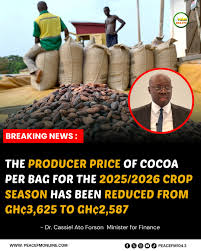
Ghana’s President John Mahama and his government announced a new cocoa producer price for the 2025–2026 crop season. The reduction of the Cocoa price has sparked anger in many Ghanaian Cocoa farmers and the minority in Ghana’s parliament
Accra, February 12, 2026—The Producer Price Review Committee (PPRC) has announced a new cocoa producer price for the remainder of the 2025–2026 crop season, following a review of current market challenges.
According to the finance minister, Cassiel Ato Forson, the decision was taken at a meeting of the PPRC held on Thursday afternoon under the chairmanship of sector authorities, aimed at assessing developments in the global cocoa market and their impact on Ghanaian farmers.
90% of Gross FOB to Cushion Farmers
He said, to protect cocoa farmers from the effects of falling global market prices, the Committee recommended that farmers be paid 90% of the achieved gross Free On Board (FOB) price of $4,200 per ton.
Officials say the move is intended to mitigate the adverse impact of declining world cocoa prices while ensuring farmers continue to receive competitive compensation.
New Producer Prices
Effective Thursday, February 12, 2026, the revised cocoa producer prices are as follows:
- GH¢41,392 per metric ton
- GH¢2,587 per bag
The adjustment will apply for the remainder of the 2025–2026 crop season.
Ensuring Sector Sustainability
Authorities described the measure as necessary to:
- Reflect current global cocoa market realities
- Inject immediate liquidity into the sector
- Expedite payments to farmers
- Safeguard the long-term sustainability of Ghana’s cocoa industry
Ghana remains one of the world’s leading cocoa producers, and pricing decisions are closely watched due to their direct impact on farmer livelihoods and national export revenues.
Further stakeholder engagements are expected as the season progresses.
Cocoa Price Cut Sparks Mixed Reactions as Minority Threatens Demonstration
The newly announced reduction in Ghana’s cocoa producer price for the 2025–2026 crop season has generated mixed reactions among farmer groups and sharp criticism from the Minority in Parliament.
While some sector players say the adjustment reflects global market realities, opposition lawmakers argue the move will severely impact the livelihoods of over one million cocoa farmers nationwide.
Support for the Adjustment
Following the announcement by the Producer Price Review Committee (PPRC), some industry stakeholders welcomed the revised pricing structure, stating it would allow for swift payments to cocoa farmers.
They explained that the adjustment is based on prevailing world market prices and is not unprecedented in Ghana’s cocoa history.
According to the Western Regional Best Farmer, “This is not the first time cocoa prices have been adjusted downward,” one stakeholder noted, referencing similar developments during the Kwame Nkrumah era. “But this time, it is not about defraying debt. It reflects the fall in global prices.”
He also welcomed the Finance Ministry’s proposal for an automatic price adjustment formula, which would allow producer prices to rise when global prices increase and adjust downward when they fall.
“That is what we all want—a transparent system. When prices go up, farmers benefit. When prices fall, we all share the burden,” he added.
The proposal is expected to be presented to Parliament for approval before implementation by COCOBOD.
COCOBOD Reforms
Concerns were raised about abandoned cocoa road projects in some regions, where contractors were reportedly paid but projects remain incomplete.
“When COCOBOD exits non-core areas like cocoa roads, it will help address these inefficiencies,” a farmer leader stated.
Officials further clarified that cocoa already purchased from farmers will be paid at the old rate, while the new price takes effect going forward.
Farmer cooperatives and extension officers are expected to engage producers nationwide to explain the changes and manage concerns.
Minority Slams Decision
However, the minority in Parliament has strongly criticized the price reduction, estimating the cut—approximately 28.6%—will significantly affect cocoa-dependent households.
“This sector is one of the most important pillars of our economy,” a minority spokesperson said. “At a time of crisis, the government should have bailed out COCOBOD instead of reducing the producer price.”
The opposition accused the government of overvaluing the national currency, arguing that policy trade-offs have negatively affected the cocoa sector.
“Cocoa farmers never enjoy the full benefit of the FOB price. Sometimes they receive as little as 40%,” the lawmaker argued. “If farmers’ incomes are being reduced by nearly 30%, then salaries and allowances of public officials should be reduced by the same margin.”
The minority has called for:
- The removal of the COCOBOD Chief Executive Officer.
- Government intervention to absorb the financial shock and restore previous price levels.
They warned that cocoa farmers are already expressing frustration and may organize demonstrations in the coming weeks.
The member of parliament for the Ofoase-Ayirebi constituency, Hon. Kwadwo Oppong Nkrumah, says, “If farmers take to the streets, we will join them,” the minority declared.
Criticism And Public Discussion
During the NPP time, the then minority NDC criticized Akufo-Addo’s government for paying cocoa farmers less than Ghc4,000. The finance minister, who was the then-minority leader, promised the cocoa farmers that if they came to power, the NDC government would pay a bag of cocoa from Ghc6,000 upwards during the 2024 election campaign. He told the farmers the NPP government under Nana Akufo-Addo is cheating the cocoa farmers. When they assumed power, they increased the cocoa price to Ghc140 instead of the Ghc6,000 they promised, which has raised many concerns about the current reduction, and many are asking, “Was it just campaign talk to deceive the cocoa farmers for votes?.
What Happens Next?
With Parliament expected to debate the automatic adjustment proposal and broader cocoa sector reforms, tensions remain high.
Ghana’s cocoa industry—a backbone of the national economy—now faces the challenge of balancing global market pressures with the welfare of more than one million farmers whose livelihoods depend on the crop.
The coming weeks may prove critical in determining whether dialogue prevails or public protests escalate.