Europe and the US allies reject the Iran war; Trump says, “We don’t need their help.”
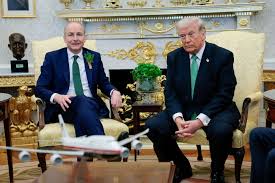
Europe and the US allies reject President Trump’s call to help the US with the Iran war. Trump responds to the rejection, “We don’t need any of their help.” Donald Trump has held talks with the Irish Taoiseach, where discussions spanned transatlantic relations, global security, and ongoing geopolitical tensions, particularly involving Iran.
During the exchange, Trump strongly criticized NATO allies, arguing that while they supported U.S. actions in principle, they failed to provide practical assistance. He said it was not good for a partnership when countries describe U.S. actions as positive but decline to help, repeating that sentiment several times to underscore his frustration.
Responding to concerns about a potential prolonged military conflict
Responding to concerns about a potential prolonged military conflict, Trump dismissed comparisons to the Vietnam War, stating he is not afraid of such an outcome. He also raised the possibility of rethinking the United States’ relationship with NATO, citing the vast financial contributions made by the U.S. over the years. According to him, the country has spent “many trillions of dollars” supporting the alliance, which he linked to ongoing budget deficits.
While Trump clarified that he has not made any immediate decision to withdraw from NATO, he emphasized that he has the authority to act independently if necessary, although he would still work with Congress. He also expressed dissatisfaction with U.S. involvement in Ukraine, claiming the war would have ended quickly without American military support under “sleepy Joe Biden,” which included what he described as hundreds of billions of dollars’ worth of advanced equipment provided at no cost.
Trump Justifies the Iran War
On Iran, Trump described the situation as primarily a military operation and claimed that U.S. forces had rapidly dismantled the country’s military capabilities. He said Iran’s navy was destroyed within days, followed by its air force and air defense systems, leaving it without radar or anti-aircraft protection. He added that U.S. forces are now able to operate freely over Iranian airspace.
Trump stated that the U.S. could further cripple Iran by targeting its electricity or oil infrastructure but has deliberately chosen not to do so. He said such actions would severely delay any future recovery, noting that rebuilding could take years. He added that the decision-making process involved senior officials, including Marco Rubio.
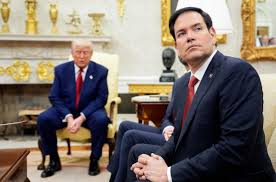
Trump comments on captured nations.
Addressing the situation in Cuba, Trump revealed that discussions are ongoing and suggested that action could be taken soon. Rubio supported this position, stating that Cuba’s economy is fundamentally broken and its political system incapable of resolving its problems. He emphasized that the U.S. embargo remains tied to political reforms and that Cuba has historically relied on external subsidies, first from the Soviet Union and later from Venezuela.
Trump also commented on U.S. relations with Venezuela, describing them as highly positive and beneficial to both sides. He briefly congratulated Venezuela’s national baseball team for reaching a major final, calling it a significant achievement.
When questioned about a long-term strategy for Iran, Trump said there is no immediate “day after” plan, arguing that the country has already been so severely weakened that rebuilding would take a decade even if U.S. forces withdrew soon. He indicated that the U.S. plans to exit in the near future but maintained that Iran has been “decimated from every standpoint.”
Trump criticizes NATO’s rejection of the Iran war
He reiterated that while Middle Eastern countries have shown strong support for U.S. actions, NATO allies have largely failed to do so. Trump specifically mentioned Keir Starmer, expressing disappointment that the United Kingdom offered military support only after the conflict had effectively been resolved. While acknowledging that he likes Starmer personally, Trump said he expected support earlier in the process.
In a historical aside, Trump pointed to a bust of Winston Churchill in his office, criticizing former President Barack Obama for previously returning it to the United Kingdom. He suggested that current leadership does not match Churchill’s legacy.
Trump Criticizes Keir Starmer and the Irish Taoiseach’s comment
In response, the Irish leader Micheál Martin emphasized the importance of maintaining strong transatlantic ties between the United States and Europe. He acknowledged that disagreements have arisen but expressed confidence that they can be resolved through continued engagement.
The Irish Taoiseach also highlighted Europe’s shared position on Iran, noting that multiple countries have imposed sanctions and designated groups such as Hamas and Hezbollah as terrorist organizations. He stressed the importance of preventing nuclear proliferation while also seeking long-term peace, drawing on Ireland’s own experience with conflict resolution.
He further noted the significance of strong relations between Ireland and the United Kingdom, adding that Keir Starmer has made efforts to improve British-Irish ties. While acknowledging historical differences, including those involving Winston Churchill, he described Starmer as a serious and constructive leader capable of working with international partners.
The Irish leader Micheál Martin concluded by reaffirming concern for the Iranian people, who he said have faced repression, and reiterated support for Ukraine, stating that Russia had invaded Ukraine. He emphasized the need for continued international cooperation to address global conflicts and maintain stability.