Agitation and mobilisation for reparations: Prof. Kimani Nehusi and the urgent case for Pan-African Coordination
[ad_1]
The ongoing debate on reparations cannot be separated from the long historical processes that produced modern global inequality. Enslavement, colonial conquest, and racial capitalism were not episodic abuses but coordinated systems that transferred African labour, land, and wealth into European accumulation.
It is within this historical frame that the interview with Prof. Kimani Nehusi was conducted, treating reparations not as retrospective grievance, but as an unresolved political question rooted in centuries of structured dispossession.
A historian, author, diasporan intellectual, and Pan-Africanist, Prof. Nehusi grounded the discussion in the deliberate erasure of African history that accompanied enslavement and colonial rule.
He traced how the denial of African civilisations, political systems, and intellectual traditions functioned to legitimise domination and extraction, while weakening African self-understanding across generations. Reparations, he argued, must therefore address not only material theft, but the systematic destruction of historical consciousness that enabled the empire to sustain itself.
From this historical foundation, Prof. Nehusi situated reparations within the present, insisting that the structures built through slavery and colonialism continue to organise global power today. His intervention rejected appeals to sympathy or symbolic recognition, emphasising organisation, political education, and Pan-African coordination as the only viable path toward accountability and redress.
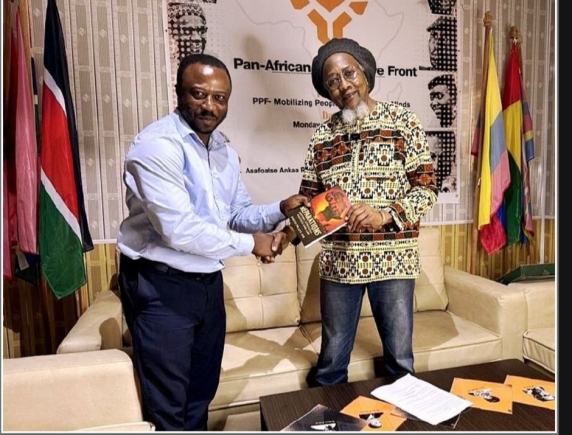
The interview took place at the headquarters of the Pan-African Progressive Front (PPF) in Accra and was coordinated by the Directorate of Public Affairs in collaboration with PPF’s blogger and the Reparations Research Team led by Sumaila Mohammed. The location was not incidental. It reflected PPF’s emerging role as a convening space for Pan-African political education, reparations research, and strategic coordination across the continent and its diaspora.
Also at the headquarters, was a symbolic presentation of the Ambassador of Pan-Africanism Medal, along with the two declarations adopted at the International Conference of Pan-African Progressive Forces held in Accra last November, and a signed copy of Kwesi Pratt’s book on Reparations, marking a moment of political recognition and continuity in the ongoing struggle for African justice.
From the outset, Prof. Nehusi rejected any framing of reparations as charity or moral appeal. “Reparations,” he stressed, “are not about sympathy. They are about responsibility.” Enslavement, colonialism, and racial capitalism, he explained, were not historical accidents but deliberate systems of accumulation that generated European wealth through African dispossession. Any serious reparations agenda must therefore confront power, not sentiment.
“Our people were not simply harmed,” he noted. “They were systematically exploited to build another world while ours was deliberately underdeveloped.” To speak of reparations without addressing this political economy, he warned, is to empty the concept of meaning.
Prof. Nehusi offered a pointed critique of fragmented activism, not as a dismissal of diasporan struggle, but as a call for greater coordination and discipline.
He acknowledged the historic role of the African diaspora as a consistent engine of resistance, from abolitionist movements to contemporary legal advocacy, grassroots organizing, and international campaigns that have kept the reparations question alive even when African states and global institutions sought to bury it.
“The diaspora has always carried the struggle,” he observed. “But struggle without coordination weakens itself.” Courts, conferences, and campaigns, he argued, are important tools, but only when anchored within a broader political strategy.
On the question of conferences and declarations, Prof. Nehusi was direct. While acknowledging their role as spaces for exchange and alignment, he cautioned against mistaking them for victory. “Ideas must move into practice,” he emphasized. “Otherwise, they remain words.”
Setting a firm tone, he stressed: “It is all about practice and a vision that must be informed. Our struggle does not end in conference halls. It continues wherever our people are.”
It was within this context that he repeatedly emphasized the importance of organization. “PPF must organize,” he stated plainly. “The Front must see itself as an instrument of Pan-Africanism and understand reparations as the most urgent and practical expression of Pan-African unity. There is nothing more revolutionary than disciplined, practical work.”
In Prof. Nehusi’s assessment, the Pan-African Progressive Front is increasingly positioning itself as infrastructure for struggle rather than a symbolic platform. Through research, political education, convening, and ideological clarity, PPF is helping to anchor reparations within a continental and diasporan framework rooted in working-class interests and historical accountability.
Responsibility, he stressed, must also be internal. “We must take responsibility for what is happening in our communities,” he said. “Owning criticism is not a weakness. It is strength.” This message, directed particularly at young Africans and people of African descent, underscored the need for honesty, self-reflection, and political maturity within the movement.
“Periodic reflection is essential,” Prof. Nehusi added. “That is how our ancestors perfected themselves. Each generation has a duty to correct itself and advance the struggle.”
In his closing remarks, Prof. Nehusi returned to the central question of collectivity. Reparations, he concluded, cannot be won through individualism or isolated action. They require disciplined movements capable of sustaining pressure over time and across borders.
“The question is no longer whether reparations are justified,” he insisted. “The question is whether Africa and its diaspora are prepared to organize at the scale history now demands.”
The task ahead, he emphasized, is collective, unapologetic, and urgent. Reparations will not be gifted. They must be organized, mobilized, and demanded.
[ad_2]
Source link